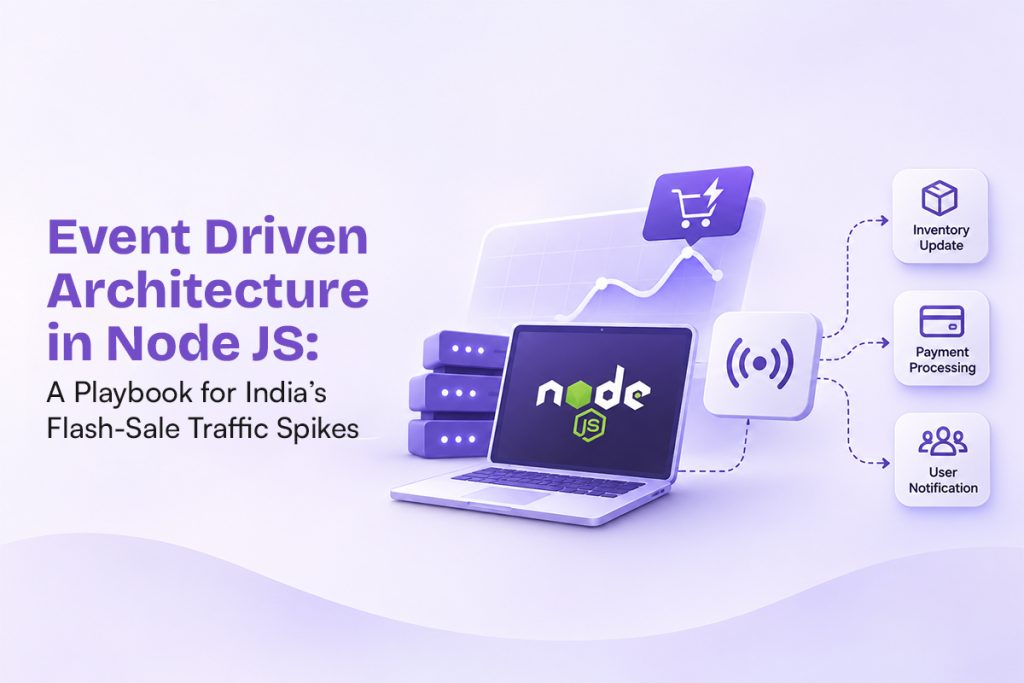


A flash sale compresses hours of normal traffic into minutes. Build a backend that absorbs sudden demand without blocking customer requests. Use event-driven architecture and queues for background processing, cluster processes to utilise CPU cores, and atomic inventory updates to prevent overselling. Extract microservices only when specific components become scaling or deployment bottlenecks.
Why Flash Sales Put Node.js Backends Under Pressure
A festive sale can turn a predictable e-commerce workload into a sudden traffic surge. When thousands of customers attempt to place orders simultaneously, the backend must process requests, communicate with payment gateways, update inventory, and trigger notifications without allowing one slow operation to block the entire checkout experience.
The first bottlenecks usually appear in a few predictable areas:
- Product-page requests generating excessive database reads.
- Checkout requests waiting for slow third-party payment gateways.
- Concurrent inventory updates creating race conditions.
- Node.js processes failing to utilise available CPU resources effectively.
- Notifications and background tasks running inside customer-facing requests.
A scalable application is not necessarily one that never slows down. It is one that manages increased demand predictably, protects critical transactions, and recovers safely when individual components fail.
Why Event-Driven Architecture Helps During Traffic Spikes
Event-driven architecture in Node.js separates the immediate customer request from background operations that do not need to finish before the response is returned.
Instead of making checkout wait for payment processing, inventory operations, and notifications to complete sequentially, the application can validate the initial request, create an order in an appropriate state, and publish events for downstream consumers.
Customer
   |
   v
Node.js Checkout API
   |
   v
Request Validation
   |
   v
Order Event
   |
   v
Message Queue
   |
   +----------+-----------+
   |          |           |
   v          v           v
Payment    Inventory  Notification
Consumer   Consumer    Consumer
   |          |           |
   +----------+-----------+
              |
              v
       Order Status Update
This approach provides several operational advantages:
- Traffic buffering: Queues absorb temporary bursts while consumers process jobs at a controlled rate.
- Service isolation: A slow notification provider does not need to block checkout.
- Independent scaling: Consumers can be scaled according to their individual workloads.
- Failure recovery: Transient failures can be retried without requiring customers to submit the original request again.
Kafka and RabbitMQ are common options, but the right choice depends on delivery requirements, throughput, ordering, retention, and operational complexity. Keep event payloads structured and versioned. Use fact-based names such as OrderPlaced and StockReserved, rather than naming events after commands.
Queue-based processing does not automatically guarantee successful transactions. Use idempotent consumers, bounded retries, dead-letter handling, and explicit order states. For payment operations, reconcile uncertain outcomes with the payment provider before retrying a potentially successful charge.
Scaling Node.js with Cluster and Worker Threads
Node.js executes JavaScript on an event loop. A CPU-intensive operation can block that event loop and delay unrelated requests handled by the same process. Modern servers often have multiple CPU cores, so a single process may not use the available compute capacity effectively.
Node.js provides two different mechanisms for handling this problem: the Cluster module and worker threads.
Cluster Module vs Worker Threads
| Technical consideration | Cluster module | Worker threads |
|---|---|---|
| Execution model | Creates separate Node.js processes. | Creates multiple threads within one process. |
| Primary purpose | Distributes incoming server connections across worker processes. | Moves CPU-intensive JavaScript work away from the main event loop. |
| Isolation | Separate process memory and failure boundaries. | Threads share a process but have separate execution contexts. |
| Typical workload | HTTP request handling across CPU cores. | Calculations and computationally intensive tasks. |
My rule is easy. Use the cluster module for HTTP load and worker threads for heavy calculations.
Put a load balancer in front and you can scale app capacity by adding more instances.
                 Load Balancer
                       |
          +------------+------------+
          |            |            |
          v            v            v
      Node.js       Node.js       Node.js
      Worker 1      Worker 2      Worker 3
          |            |            |
          +------------+------------+
                       |
                 Shared Services
                       |
             Database / Redis / Queue
Use clustering when you need multiple server processes to handle incoming traffic. Use worker threads when CPU-heavy JavaScript tasks need separate execution threads. These mechanisms solve different problems and can coexist in the same application.
For implementation details, consult the official Node.js Cluster documentation. Evaluate worker threads against the workload before introducing them.
A load balancer can distribute requests across multiple application instances, allowing the backend to scale beyond a single machine. A production-ready Node.js development approach should account for process management, health checks, graceful shutdown, and deployment configuration.
How to Prevent Overselling During a Flash Sale
Exceeding available stock during a flash sale can quickly erode customer confidence.
100
50
0
Orders accepted (illustrative)
Overselling risk with 100 units in stock (illustrative example).
Use Atomic Stock Decrements
Inventory consistency becomes critical when multiple customers attempt to purchase the last available units at the same time. A conventional check-then-update sequence can create a race condition:
Request A: Read stock = 1
Request B: Read stock = 1
Request A: Place order
Request B: Place order
Result: Two orders for one unit
The problem is that checking availability and decrementing stock are separate operations. Both requests can read the same available quantity before either update is committed.
Redis can perform an inventory update atomically. A conditional Lua script can check the available quantity and decrement it as one operation, preventing concurrent requests from reserving the same unit.
if stock > 0 then
    stock = stock - 1
    return stock
else
    return -1
end
This is illustrative decision logic. Production code should execute the conditional check and decrement atomically within Redis rather than implementing them as separate application calls.
Redis can act as a fast reservation layer, but the system still needs a durable inventory record and reconciliation process. Add database-level safeguards such as conditional updates, transaction boundaries, or version checks. Make reservation expiry and release behaviour explicit when payment fails or remains pending.
Important: An atomic Redis decrement protects the Redis operation, not the entire order-payment-database workflow. Use idempotency, durable order states, and reconciliation to handle failures between these systems.
When to Migrate from a Monolith to Microservices
Not every e-commerce application needs microservices from the beginning. A well-structured monolith can support substantial growth while keeping deployment, testing, and data management relatively simple.
Consider extracting services when operational evidence shows that:
- Changes to one feature repeatedly disrupt unrelated functionality.
- Checkout or inventory needs independent scaling.
- Teams cannot release features without coordinating every deployment.
- One component’s performance problems affect the entire application.
When migration becomes necessary, use an incremental approach rather than rewriting the entire backend.
The Strangler Fig Migration Pattern
The Strangler Fig pattern gradually replaces selected monolith functionality with independently deployed services. A routing layer directs specific requests to the new implementation while the remaining application continues operating.
             Incoming Requests
                     |
                     v
               API Gateway
                 /      \
                v        v
          Existing      New
          Monolith     Service
                \        /
                 v      v
             Shared Integration
                     |
                     v
              Verified Results
A practical migration sequence is:
- Identify the component causing the greatest operational bottleneck.
- Define its service boundary and data ownership.
- Build the replacement behind an established API contract.
- Route a controlled portion of traffic to the new service.
- Compare results, monitor errors, and retain a rollback path.
- Remove the corresponding monolith functionality only after verification.
Event-based communication can connect the old application and new services during migration. Version event schemas, preserve correlation identifiers such as order IDs, and test compatibility before changing production traffic.
The monolith vs microservices architecture decision should be based on deployment independence, scaling requirements, data boundaries, and team ownership—not on the assumption that microservices are automatically more scalable.
For a deeper explanation of the migration approach, see AWS guidance on the Strangler Fig pattern.
Monitoring Backend Health During a Flash Sale
Infrastructure capacity alone does not tell you whether a sale is running successfully. Monitor the application and its dependencies throughout the event.
- Queue depth and consumer lag: Identify whether background processing is falling behind.
- Checkout error rate: Detect failures in the most commercially important journey.
- Event-loop delay: Identify processes blocked by synchronous or CPU-heavy operations.
- Inventory consistency: Reconcile reserved stock in Redis against durable database records.
- Payment status: Track pending, successful, failed, and uncertain transactions.
- API latency: Monitor response times at relevant percentiles, not just averages.
Define alert thresholds using normal operating baselines and rehearse recovery procedures before the sale. Logs, metrics, and distributed traces should share correlation IDs so engineers can follow an order across APIs, queues, and consumers.
A Practical Implementation Order
Teams preparing for a major sale should improve the existing backend in a controlled sequence:
- Load-test the current application and identify its first bottleneck.
- Scale Node.js processes across available CPU cores where appropriate.
- Move non-critical background operations into queues.
- Implement atomic inventory reservations and durable database safeguards.
- Add idempotency, retry limits, monitoring, and failure alerts.
- Rehearse payment failures, queue backlogs, and rollback procedures.
- Extract individual services only when the evidence supports migration.
Common mistakes include testing with unrealistic traffic, adding queues without retry controls, ignoring third-party service latency, sharing data without clear ownership, and launching without a rollback plan.
When the existing architecture needs a broader assessment, Cuneiform Consulting’s services can support teams in planning backend improvements and application modernisation around specific delivery requirements.
Conclusion
Flash-sale readiness depends on more than adding servers. A resilient Node.js backend needs asynchronous processing, effective CPU utilisation, atomic inventory control, and visibility into every critical transaction.
Start with load testing and fix the first bottleneck. Introduce queues and inventory safeguards before considering a larger architectural migration. A focused, measurable improvement is more valuable than a complete rewrite that has not been validated under real traffic conditions.
Frequently Asked Questions
How do you scale a Node.js backend application?
Scale a Node.js backend by running multiple processes across available CPU cores, distributing requests through a load balancer, and moving non-critical operations into background queues. Add caching, database optimisation, and monitoring based on measured bottlenecks.
What is the difference between the Cluster module and worker threads in Node.js?
The Cluster module creates separate Node.js processes that can share incoming server connections. Worker threads run JavaScript in separate threads within a process and are useful for CPU-intensive tasks. They address different scaling requirements and can be used together.
How can flash-sale traffic surges be managed in a Node.js backend?
Use load balancing, queue-based background processing, caching, and controlled consumer scaling to absorb traffic spikes. Protect checkout with idempotent operations and atomic inventory reservations, and monitor queue lag, API errors, and payment status throughout the sale.
When should an e-commerce application migrate from a monolith to microservices?
Consider migration when specific components require independent scaling, deployments repeatedly affect unrelated features, or team dependencies slow delivery. Start with one service boundary and migrate incrementally rather than rewriting the entire application.
How do you prevent overselling during a flash sale?
Use an atomic conditional stock decrement, such as a Redis Lua script, to prevent concurrent requests from reserving the same inventory. Add database-level safeguards, idempotent order handling, reservation expiry, and reconciliation to protect the complete transaction.