
TL;DR: Multi-agent AI architecture divides a complex workflow among multiple specialised AI agents that coordinate through defined interfaces, shared state, or an orchestrator. It can improve modularity and task coverage, but it also introduces communication overhead, latency, cost, and new failure modes. Start with a single agent, introduce multiple agents only when evaluation shows a measurable benefit, and design for observability, permissions, recovery, and human oversight before production deployment.
What Is Multi-Agent AI Architecture?
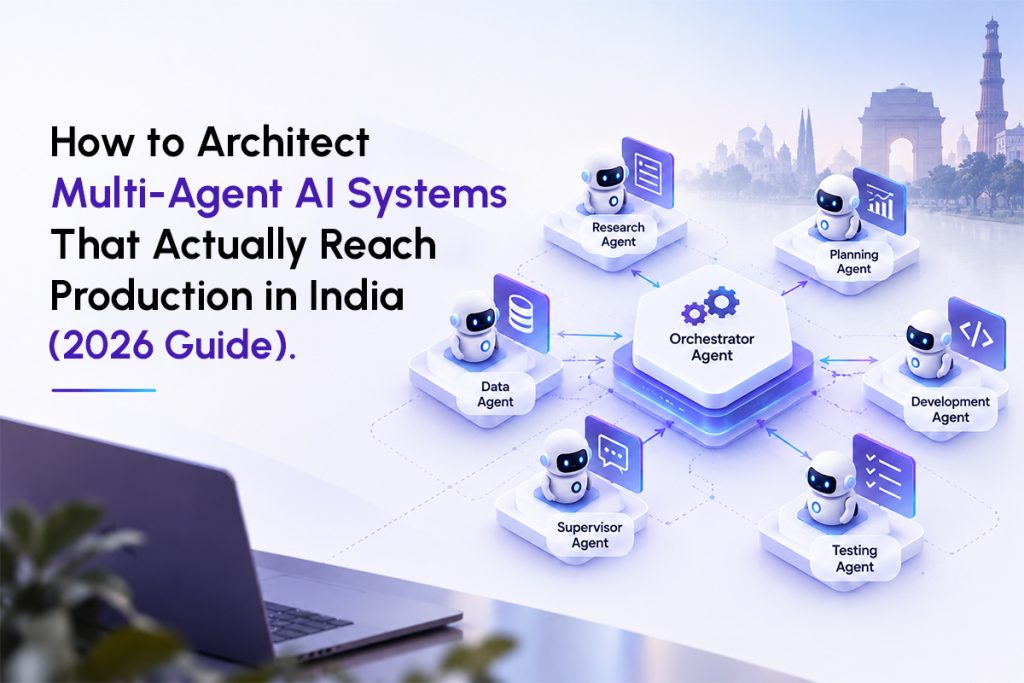
Multi-agent AI architecture is a system design in which two or more AI agents collaborate to complete a task. Each agent may have a defined role, a set of tools, specific instructions, and access to selected context. A coordination mechanism determines how work is assigned, how results are passed between agents, and when the overall task is complete.
For example, an enterprise workflow might use one agent to extract information from documents, another to validate the extracted fields, and a third to identify exceptions for human review. These agents are not automatically reliable simply because they are specialised. Their outputs must be validated, and the system must define what happens when agents disagree or fail.
Single-Agent vs Multi-Agent Systems
A multi-agent system is not always the better choice. Every additional agent introduces another execution step, another potential failure point, and often additional model calls. Architecture should follow the complexity of the task rather than the appeal of a more elaborate AI design.
| Consideration | Single-agent architecture | Multi-agent architecture |
|---|---|---|
| Workflow complexity | Best for bounded tasks with a clear objective | Useful for tasks with distinct subtasks or specialised responsibilities |
| Coordination | Usually simpler to manage | Requires explicit task handoffs and coordination rules |
| Latency and cost | Often lower for straightforward requests | Can increase with additional agents and model calls |
| Testing | Fewer execution paths | Requires testing individual agents and the complete workflow |
| Best fit | Classification, retrieval, and bounded tool use | Complex research, document processing, and multi-stage workflows |
Before adopting multiple agents, establish a baseline using a single-agent implementation. Compare task success, factual accuracy, total latency, token usage, operational cost, and human intervention rates. Add agents only when the measured improvement justifies the additional complexity.
Core Components of an AI Agent Architecture
1. Agents and Responsibilities
Each agent should have a clearly defined responsibility and output contract. An extraction agent, for example, should return structured fields and confidence or validation information rather than an unrestricted narrative. Narrow responsibilities make individual components easier to evaluate and replace.
2. Orchestration and Task Routing
The orchestrator controls task assignment, execution order, retries, timeouts, and completion criteria. It can be implemented as deterministic application logic, a workflow engine, or an AI-based coordinator. Use deterministic rules for critical business decisions wherever possible instead of relying on an LLM to control every transition.
3. State and Context Management
Agents need access to relevant information without receiving the entire conversation or every intermediate result. Store workflow state explicitly and pass only the context required for each task. Define which component can read or modify each field, how state is versioned, and how sensitive data is handled.
4. Tools, APIs, and Data Access
Agents may call internal APIs, retrieve documents, query databases, or use external services. Every tool should have a defined schema, authentication mechanism, permission boundary, and timeout. Apply least-privilege access and validate tool arguments before execution. An agent should not receive unrestricted database or production-system access simply because its workflow requires data.
5. Evaluation and Observability
Record each task’s execution path, model and prompt versions, tool calls, validation outcomes, latency, token usage, and errors. Use trace identifiers to connect related agent operations. Redact sensitive information from logs and establish retention controls. Evaluation should cover the complete business outcome, not just whether an individual agent produced a plausible response.
Four Common Multi-Agent Architecture Patterns
Orchestrator and Workers
A central orchestrator decomposes a request, delegates subtasks to specialised agents, and combines validated results. This pattern is useful when a task requires multiple forms of analysis but still needs a central component to control the final result.
                 User Request
                       |
                       v
                Orchestrator
                 /    |    \
                v     v     v
           Research  Data  Validation
             Agent  Agent    Agent
                \     |     /
                 v    v    v
              Result Validation
                       |
                       v
                 Final Response
The orchestrator should define task boundaries, enforce completion conditions, and reject incomplete or inconsistent outputs. Parallel workers can reduce elapsed time when their tasks are genuinely independent, but they may increase total model usage.
Sequential Pipeline
Agents execute in a defined sequence, with each stage consuming the previous stage’s validated output. This is suitable for document extraction, transformation, verification, and approval workflows.
Input
  |
  v
Extraction Agent
  |
  v
Validation Agent
  |
  v
Business Rules Engine
  |
  v
Human Review (when required)
  |
  v
Approved Output
Each stage should validate its input and output. If a stage fails, the system should retry only when appropriate, route the item for review, or stop safely. Avoid repeating an entire workflow when only one stage needs recovery.
Router-Based Architecture
A router classifies an incoming request and sends it to the most suitable specialist. This can be effective for customer support, internal knowledge systems, and enterprise assistants serving different business functions.
                 Incoming Request
                         |
                         v
                       Router
                   /     |      \
                  v      v       v
              Finance  Support  Technical
                Agent   Agent     Agent
                  \      |       /
                   v     v      v
                  Response Validation
                         |
                         v
                        User
Routing rules should include a fallback for uncertain classifications. Requests involving restricted actions, sensitive information, or high-impact decisions may require deterministic routing and human approval rather than unrestricted model-based selection.
Hierarchical Multi-Agent Architecture
A lead agent coordinates sub-orchestrators, which manage specialist agents for larger workflows. This pattern can support complex research or enterprise operations with multiple workstreams, but it also increases the difficulty of tracing decisions and controlling execution cost.
                 Primary Coordinator
                    /           \
                   v             v
             Workstream A    Workstream B
              /      \        /      \
             v        v      v        v
          Agent A1  Agent A2 Agent B1 Agent B2
              \       /        \      /
               v     v          v    v
                Validated Workstream Results
                           |
                           v
                    Final Aggregation
Use hierarchical coordination only when simpler patterns cannot manage the workload effectively. Define limits for delegation depth, agent count, execution time, and total model or tool expenditure.
Choosing a Framework: LangGraph, CrewAI, or AutoGen
Framework selection should follow the workflow’s operational requirements rather than popularity alone. Compare state management, execution control, integrations, debugging, deployment requirements, and the team’s existing engineering skills.
- LangGraph: Consider it when you need graph-based workflow control, explicit state transitions, and support for long-running or interruptible processes.
- CrewAI: Consider it when the application benefits from role-oriented agent collaboration and task delegation.
- AutoGen: Consider it when conversational coordination among agents is central to the workflow and the chosen version supports your deployment requirements.
These tools evolve, and their capabilities overlap. Validate current documentation, version compatibility, observability support, and production constraints before committing to a framework. For a simple workflow, ordinary application code may be easier to maintain than an agent framework.
For implementation, start with a clear technical roadmap through strategy consulting and define the system’s delivery scope before introducing orchestration complexity.
Common Failure Risks in Production
Unbounded Agent Loops
Agents may repeatedly delegate tasks, retry failing tools, or continue reasoning without reaching a useful result. Set maximum steps, execution deadlines, retry limits, and cost budgets. Stop the workflow when its completion conditions cannot be met.
Incorrect or Conflicting Outputs
Two agents may return contradictory findings, or an upstream agent may pass an incorrect assumption to every downstream stage. Use structured outputs, schema validation, source verification, and business-rule checks. Do not treat agreement between AI agents as proof that a result is correct.
Tool Failures and Duplicate Actions
External APIs can time out, return malformed data, or process a request even when the client receives no response. Use timeouts, controlled retries, idempotency keys for supported operations, and explicit status tracking. Require human confirmation before irreversible or high-impact actions.
Prompt Injection and Excessive Permissions
Retrieved documents, emails, and web pages may contain instructions designed to manipulate an agent. Treat external content as untrusted data, separate it from system instructions, restrict tool permissions, and validate every action at the application boundary.
Uncontrolled Cost and Latency
Multiple agents can multiply model calls and context usage. Track cost and latency per workflow, limit unnecessary context, cache suitable results, and use smaller or less expensive models for tasks that do not require advanced reasoning. Establish service-level targets and test under realistic workloads.
Production principle: Every agent should have a defined purpose, bounded permissions, measurable success criteria, and a safe failure path. If a component cannot be evaluated or controlled, it is not ready for a critical production workflow.
Example: Multi-Agent AI for an NBFC Loan Document Workflow in India
Consider a non-banking financial company processing loan applications with supporting identity, income, and bank documents. A multi-agent system can assist with document handling while keeping eligibility decisions and disbursement controls within approved business systems.
Loan Application
       |
       v
Document Intake and Classification
       |
       v
Field Extraction Agent
       |
       v
Cross-Document Validation Agent
       |
       v
Business Rules and Exception Checks
       |
       +------> Incomplete / Conflicting Data
       |                    |
       |                    v
       |               Human Review
       v
Approved Data Package
       |
       v
Authorised Decision System
       |
       v
Auditable Outcome
The extraction agent identifies relevant fields, while the validation agent checks consistency across documents. A deterministic rules engine evaluates defined conditions, and exceptions go to an authorised reviewer. The system should never infer that a document is genuine or a borrower is eligible merely because an AI agent reports confidence.
Before deployment, assess applicable privacy, security, financial-sector, and record-retention obligations. Minimise personal data shared with models, control access to documents, protect logs, and document human review and escalation procedures. Legal compliance must be assessed against the rules applicable to the specific institution and use case.
When integrating agents into existing enterprise systems, a well-scoped custom software development approach can help establish reliable APIs, validation layers, and operational controls. For wider process change, align the architecture with a structured digital transformation services roadmap.
Production Readiness Checklist
- Define the business problem and compare the multi-agent approach against a single-agent baseline.
- Give every agent a bounded role and a documented input/output contract.
- Set execution limits for delegation, retries, runtime, and total cost.
- Validate structured outputs and enforce business rules outside the model.
- Apply least-privilege permissions to every tool, API, and data source.
- Test prompt injection, conflicting outputs, malformed data, timeouts, and partial failures.
- Instrument traces, model calls, tool results, latency, token usage, and error rates.
- Define human approval for sensitive, irreversible, or high-impact actions.
- Run evaluations against representative real-world cases before release.
- Establish monitoring, rollback, incident response, and version management procedures.
For an example of how architecture decisions affect maintainability and scaling, review Cuneiform’s guide to monolith vs microservices architecture. The same principle applies to AI systems: choose the simplest design that meets the operational requirements.
Conclusion
Multi-agent AI architecture can make complex workflows more modular by assigning specialised tasks to separate agents and coordinating their outputs. Its value depends on disciplined orchestration, explicit state management, reliable tool integration, and rigorous evaluation.
Do not measure success by the number of agents in a system. Measure whether it improves task completion, accuracy, reliability, and total operating cost against a simpler baseline. Begin with a narrow use case, test failure conditions, introduce human oversight where necessary, and expand only when production evidence supports the investment.
Frequently Asked Questions
What is the difference between single-agent and multi-agent AI architecture?
A single-agent system handles a task through one agent, while a multi-agent system distributes work among multiple agents with defined responsibilities. Multi-agent architecture can help with complex workflows, but it usually adds coordination overhead, model calls, and more failure points. Choose it when testing demonstrates a meaningful advantage.
Which framework is better for multi-agent AI: LangGraph, CrewAI, or AutoGen?
There is no universal winner. LangGraph is worth evaluating for graph-based stateful workflows, CrewAI for role-oriented collaboration, and AutoGen for conversational agent coordination. Compare the current versions against your requirements for execution control, integrations, observability, deployment, and maintainability before deciding.
What are the biggest risks of multi-agent AI in production?
Common risks include unbounded loops, incorrect outputs, conflicting agent decisions, tool failures, prompt injection, excessive permissions, rising costs, and unpredictable latency. Mitigate them with execution limits, structured validation, least-privilege access, monitoring, failure recovery, and human approval for high-impact actions.
How do AI agents communicate with each other and external tools?
Agents can pass structured messages, task results, or shared workflow state through an orchestrator or a defined communication mechanism. External tools are typically accessed through APIs or controlled tool interfaces. Use explicit schemas, authentication, permission checks, timeouts, and validation rather than allowing unrestricted agent-to-agent or agent-to-system access.
When should a business avoid multi-agent AI architecture?
A business should avoid it when a single agent or conventional workflow already meets the requirements, when the task is straightforward, or when the added cost and complexity cannot be justified. It is also unsuitable for production use when outputs cannot be validated, permissions cannot be controlled, or failures cannot be detected and safely handled.