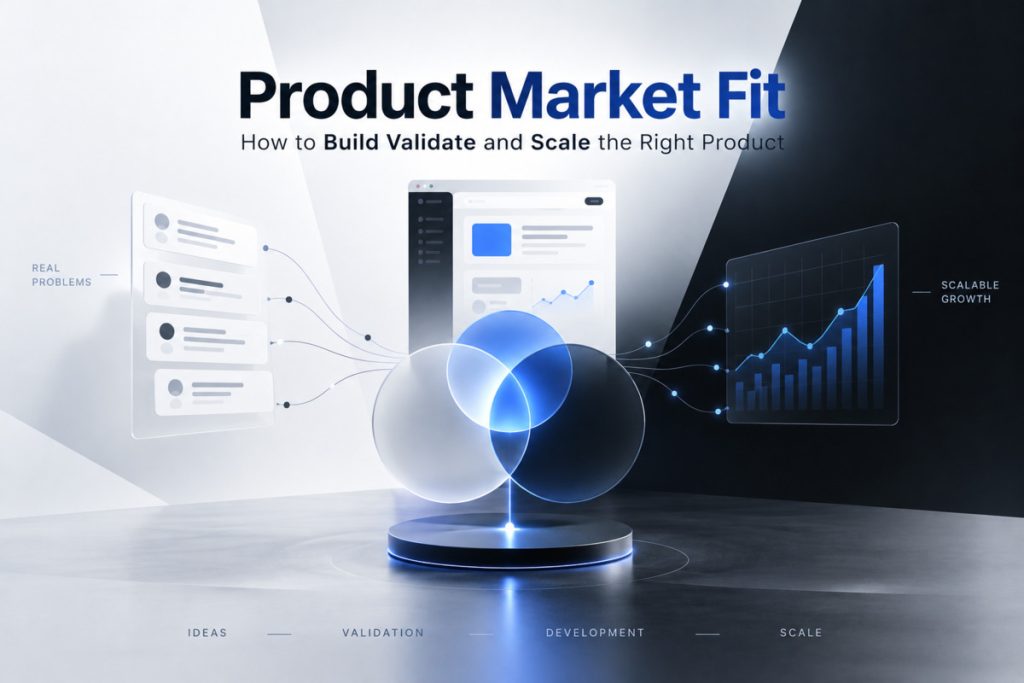



tl;dr
Product market fit means your product solves a real problem for a real market and people are willing to pay for it
You reach product market fit through research testing and honest listening not guessing
A structured product validation process saves months of wasted development time
Working with the right product strategy consulting partner speeds up the entire journey
This guide walks you through every stage from idea to scale using real world examples
Introduction
Every founder has felt this fear at some point. You build something you believe in. You launch it. And then silence. No signups no calls no interest. This is the moment most products die and it happens because product market fit was never actually confirmed before money and time went into building.
Product market fit is not a buzzword thrown around in pitch decks. It is the single biggest reason startups succeed or shut down. Marc Andreessen once described it as the moment when a market pulls a product out of a company rather than a company pushing a product into a market. When that pull happens growth stops being a struggle and starts being a natural result.
In this article you will learn what product market fit really means the different types of fit you can achieve why it matters so much right now how modern product development is changing the benefits of getting this right how to actually get started and where this entire space is heading next.
What Is Product Market Fit
Product market fit is the point where a product satisfies a strong market demand so well that customers actively want it use it repeatedly and tell others about it. It is not about having a nice looking app or a clever feature list. It is about solving a real painful problem better than anything else available.
A product without market fit might have users but they churn fast. A product with true fit has users who get frustrated if the product goes down for even an hour. That emotional attachment is the real signal.
Some practical signs that fit exists include
- Customers keep coming back without being reminded
- Word of mouth referrals grow faster than paid marketing
- Support requests are about adding features not fixing confusion
- Retention curves flatten instead of dropping toward zero
- Sales conversations get shorter because the value is obvious
Types of Product Market Fit
Problem Solution Fit
This is the earliest stage. You have identified a real problem and a rough idea of a solution but nothing has been tested with actual users yet.
Product Market Fit
This is the classic stage where a working product meets a defined market and demand becomes measurable through usage retention and revenue.
Channel Market Fit
Even if you get a great product to customers via the wrong channel, it can fail. Channel fit is when you’ve found the marketing or sales channel that reliably delivers the right customers to you at a sustainable cost.
Business Model Fit
The last layer is proving the economics work at scale. This is when the cost of acquiring and retaining a customer is less than the value that customer brings in the long run.
Why Product Market Fit Matters
Building something is not the hardest thing for founders and product teams to do today. Tools like no code platforms and AI assistants are making building faster than ever. The real challenge is building something people actually need.
Studies on startup failure consistently point to the same root cause again and again which is that there was no market need for the product. Companies burn through funding building features nobody asked for while ignoring the handful of complaints that actually mattered. For a deeper look at how leading firms structure this discovery phase you can review this breakdown of product market fit fundamentals from Andreessen Horowitz which remains one of the most referenced frameworks in the startup world.
How Product Market Fit Is Changing Product Development
Research
Teams no longer rely solely on surveys. They combine customer interviews, behavioral data and support tickets to get a real picture of pain points before they write a single line of code.
Brainstorming
Today’s ideation is fast and collaborative. Cross functional teams of designers, engineers and sales people sit together early instead of ideas being handed down from leadership alone.
Design.
Design has moved from decoration to framing problems. Wireframes and prototypes are tested in days, not months, thanks to rapid feedback loops with real users.
Dev-Build
This is where many teams opt to bring in external expertise. Custom Application Development partners let internal teams focus on strategy while experienced engineers deliver the technical build quickly and accurately.
Launch
Launches today are staged and controlled. Instead of one big release teams roll out to small user groups first watch behavior closely and expand only once the signal is strong.
What Are the Benefits of Product Market Fit
Faster Organic Growth
When people genuinely need your product they tell others without being asked and this reduces your dependence on paid advertising.
Lower Customer Acquisition Cost
A product that sells itself through word of mouth and strong retention naturally lowers the cost of bringing in new customers.
Higher Investor Confidence
Investors look for proof of demand before writing checks and demonstrated fit is the strongest proof a founder can offer.
Stronger Team Morale
Teams that see real customers benefit from their work stay motivated far longer than teams building in the dark.
Clearer Roadmap Decisions
Once fit is confirmed every future feature decision becomes easier because you know exactly who you are building for and why.
How to Get Started with Product Market Fit
Understand Your Starting Point Before building anything map out what you already know about your customer their daily frustrations and how they currently solve the problem without your product.
Identify the Best Use Cases Not every customer segment deserves equal attention. Find the narrow group feeling the most pain right now and design specifically for them first.
Choose the Right Tools Whether you are exploring mvp development services or building fully custom software the tools and partners you choose should match your speed and budget needs not just trends.
Build the Right Team Early stage product work needs generalists who can wear multiple hats. As the product matures you can bring in specialists for scale and polish.
Measure Results ROI Track retention referral rates and revenue per customer closely. These numbers tell the real story far better than vanity metrics like total downloads or social media likes.
| Service Area | Typical Monthly Search Volume | Competition Level |
|---|---|---|
| Product Market Fit Research | 1300 | High |
| Product Strategy Consulting | 30 | Low |
| Product Development Services | 30 | Low |
| Custom Application Development | 880 | Medium |
| Product Validation Process | 20 | Low |
| Digital Product Development | 720 | Medium |
| MVP Development Services | 720 | Low |
A real world example makes this easier to picture. A small logistics startup once believed their core value was route optimization software. After running structured customer interviews they discovered warehouse managers cared far more about a simple driver communication feature that had been treated as an afterthought. Once the team rebuilt their roadmap around that discovery retention jumped within a single quarter. This is the kind of insight that only comes from talking to real users rather than guessing from a boardroom.
The Future of Product Market Fit
AI Assisted Discovery
Teams are now using AI tools to analyze thousands of support tickets and reviews in minutes surfacing patterns that used to take analysts weeks to find manually.
Continuous Fit Rather Than a One Time Milestone
Markets shift fast so fit is increasingly treated as something to monitor continuously rather than a box checked once and forgotten.
Micro Segmentation
Instead of chasing one broad market more teams are finding fit within small tightly defined segments first before expanding outward.
Challenges and Ethical Considerations
As more decisions get automated through data and AI companies must stay careful not to lose the human judgment that originally uncovered the problem worth solving in the first place. For teams researching how this balance is being studied academically the overview on product market fit theory on Wikipedia offers useful historical context on how the concept evolved.
Cuneiform Consulting Can Help You Get There
Finding real product market fit is rarely a straight line. It takes honest research disciplined testing and a willingness to change direction when the data says so.
At Cuneiform Consulting we work alongside founders and product teams to turn assumptions into evidence and evidence into products people genuinely want. Whether you need help with early stage validation or full scale digital product development, our team brings the structure and experience to get you there faster.
If you are ready to stop guessing and start building something the market actually wants reach out to Cuneiform Consulting today and let us help you build validate and scale the right product from day one.